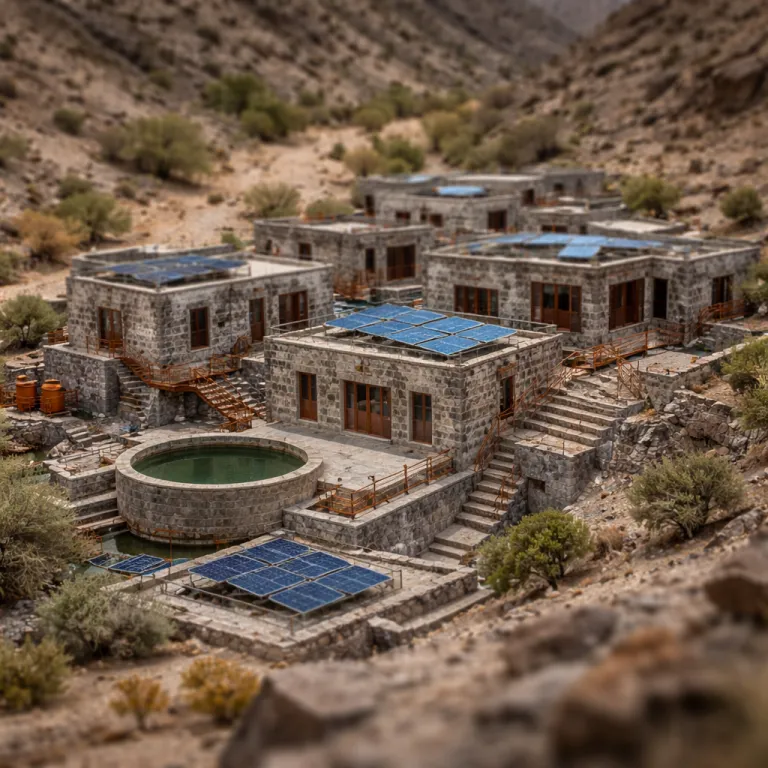
Feynan ecolodge as Jordan’s off grid benchmark
Feynan Ecolodge sits at the end of a rough desert track in southern Jordan, where the asphalt fades and the wadi begins to breathe. This is not a symbolic green gesture but a genuinely off grid lodge whose operations are shaped by the Dana Biosphere Reserve around it, by the local Bedouin families of Wadi Feynan, and by the hard arithmetic of running a serious property on solar power. For travelers used to urban luxury, the first impression is disarming yet precise, because every small detail from the candle lit corridors to the clay jugs of water has an operational logic behind the romance.
The property was developed by the Royal Society for the Conservation of Nature (RSCN) and is operated by EcoHotels as a flagship ecolodge in Jordan, with 26 rooms arranged around shaded courtyards that stay cool through natural ventilation rather than mechanical excess. RSCN describes Feynan as “one of the top 25 ecolodges in the world,” a claim repeated in RSCN and EcoHotels promotional material, and EcoHotels highlights it as a model for community based tourism in Jordan. That makes Feynan Ecolodge both a lodge and a living laboratory, where each guest night must balance comfort, conservation and the needs of the local community that supplies staff, guides and much of the food. When you visit, you are stepping into a nature reserve economy where every kilowatt, every litre of water and every job for a local Bedouin household is counted carefully rather than abstracted away.
The setting is austere and magnetic, framed by the ochre cliffs of Wadi Feynan on the western side of the Dana Biosphere and by the long hiking routes that link Feynan Jordan with Dana village and eventually Petra. Solo travelers arrive here after days in Wadi Rum or Amman and find a different tempo, one where the best luxury is time under the sun on the rooftop terrace, watching the light slide across the biosphere reserve. The ecolodge offers guided hiking, cooking classes and cultural experiences that are deliberately small scale, so the experience remains intimate for travelers while the impact on the surrounding nature reserve stays within what the fragile Dana landscape can absorb.
The candlelight question and the real cost of solar serenity
Guests often speak first about the candle lit evenings at Feynan Ecolodge, when the lodge glows like a desert caravanserai and the stars above Wadi Feynan feel almost close enough to touch. The aesthetic is powerful, yet the decision to rely on candles in guest areas after sunset is also a hard headed load management strategy that keeps the solar system focused on essentials such as refrigeration, water pumps and the minimal lighting needed behind the scenes. In a remote wadi where the grid does not reach, Feynan eco operations must treat every ampere as a scarce resource rather than an invisible utility.
Solar panels on the lodge roof and nearby structures generate the electricity that powers the ecolodge’s core systems, but the array is sized for realism, not extravagance. RSCN and EcoHotels note that the lodge runs primarily on photovoltaic energy, supported by batteries that are carefully monitored to avoid deep discharge. Air conditioning units, for example, would blow through the available capacity in hours, so the architecture leans on thick stone walls, cross ventilation and shaded courtyards to keep rooms comfortable even when the sun is high over the biosphere reserve. For travelers, this means packing light natural fabrics, a headlamp for moving around the candle lit corridors, and understanding that the best cooling often comes from the desert breeze at night and from the rhythm of the hiking day rather than from a thermostat.
This energy discipline extends to water heating, kitchen equipment and even the timing of certain staff activities, because the local community working at the lodge has learned to align chores with the solar curve. When you visit Feynan, guides will often explain how batteries are checked, how backup systems are used sparingly and why some plugs in guest rooms are limited, turning the stay into a quiet masterclass in resource literacy. If you are interested in broader protected landscapes, it is worth pairing this stay with a journey north to Jordan’s other conservation stories, such as the Yarmouk forests and their UNESCO biosphere status, which are explored in depth in an article on Jordan’s quiet northern counterpoint on myjordanstay.com.
Fifty local jobs and a community shaped by a lodge
The most significant number at Feynan Ecolodge is not the room count or the length of the Dana to Petra hike, but the roughly fifty permanent jobs held by local Bedouin men and women from the surrounding community. EcoHotels reports that more than 80% of staff come from villages around Wadi Feynan, and that salaries ripple through extended families, paying for school fees, healthcare and the small daily costs that keep people rooted rather than forced to migrate. For solo travelers, meeting the local Bedouin staff is often the most memorable part of the experience, because the Feynan model turns employees into cultural interpreters rather than anonymous service workers.
Roles range from guides leading hiking routes through the Dana Biosphere to drivers handling the final transfer into Wadi Feynan, from cooks preparing vegetarian dishes to women who host cooking classes in nearby tents, and from maintenance teams who understand every pipe in the eco lodge to receptionists who can explain the best time to visit each trail. The lodge purchases bread, dairy and other staples from the local community whenever possible, while dry goods and fresh produce that cannot be grown in this arid corner of Feynan Jordan travel in from towns on the plateau, creating a supply chain that is lean but reliable. For guests, this means menus that follow the seasons and the realities of the nature reserve, with sun dried tomatoes, lentils and herbs often taking centre stage over imported luxuries.
Economic impact is also social impact, and you feel it when a guide points out his family’s herd grazing near the wadi or when a driver explains how his children now see tourism as a viable path. The Royal Society for the Conservation of Nature and EcoHotels both frame Feynan eco operations as a partnership with the local community rather than a top down project, which is why the ecolodge offers structured cultural experiences instead of casual intrusion into private tents. For readers interested in how this fits into Jordan’s wider hospitality landscape, myjordanstay.com has a detailed guide to sustainable luxury and premium hotel booking experiences in Jordan that situates Feynan alongside urban and coastal properties.
Dana Biosphere Reserve, food miles and the limits of replication
Location is destiny for any lodge, and Feynan Ecolodge owes much of its character to its position inside the Dana Biosphere Reserve at the Wadi Feynan edge. This is a nature reserve where four biogeographical zones meet, which means that hiking here can take you from baked sandstone near Wadi Ghwayr to cooler uplands closer to Dana village, all within a day’s travel. The lodge acts as a low impact anchor in this landscape, channelling travelers along established trails and concentrating overnight stays in one footprint rather than scattering ad hoc camps across fragile Dana nature.
Food logistics illustrate why the Feynan Jordan model is both inspiring and hard to copy, because the ecolodge must balance local sourcing with the realities of an arid biosphere reserve. Some vegetables, herbs and dairy products come from families in the local community or from higher altitude farms near Dana, while staples such as grains and certain fruits arrive via a carefully planned supply chain that snakes down into Wadi Feynan. Every delivery has a fuel cost and a time cost, so menus are designed to minimise waste and to celebrate dishes that travel well, turning what could be a constraint into a culinary identity rooted in the reserve.
Developers who tour Feynan eco operations often assume the concept can be transplanted wholesale to other wadis or even to Wadi Rum, yet the combination of RSCN ownership, EcoHotels management and deep local Bedouin partnerships is unusually specific. The lodge benefits from being part of a wider RSCN ecosystem of protected areas, which provides regulatory backing, conservation science and a clear mandate that profit must support nature reserve goals rather than override them. For travelers comparing ecolodge offers across Jordan, this means Feynan Ecolodge is less a template and more a reference point, a reminder that true sustainability depends on governance, geography and community as much as on solar panels and good intentions.
Designing a two night solo stay around hikes, stars and silence
For a solo explorer planning a stay at Feynan Ecolodge, two nights is the sweet spot that allows you to feel the rhythm of the lodge without rushing. Arrive from Amman, Petra or Wadi Rum by midday if possible, allowing roughly three to four hours’ drive from Amman and around two hours from Petra or Wadi Rum, so you can settle into your small but thoughtfully designed room, meet the local Bedouin guides and join the afternoon hike that usually ends with tea as the sun sinks behind the ridges of Wadi Feynan. After dinner, the rooftop becomes an open air observatory where staff point out constellations and planets, and where the absence of grid light turns the sky into one of the best shows in Jordan.
The second day is your chance to go deeper into the Dana Biosphere, either on a half day hiking route towards Wadi Ghwayr or on a longer trek that samples the famous Dana to Petra trail without committing to the full multi day journey. Guided walks weave through the nature reserve, explaining how plants, wildlife and the local community have adapted to this harsh yet generous environment, while optional cooking classes introduce you to recipes that rely on lentils, herbs and sun dried ingredients that suit the climate. Between activities, the lodge itself becomes part of the experience, from the candle lit library where you can read in quiet to the shaded terraces where you can simply watch the play of light on the surrounding Dana nature.
On your final morning, consider an early hike to a viewpoint above the wadi before your transfer out, using the cool hours to imprint the landscape before you return to the road network. If your Jordan travel itinerary allows, you can then head north or south, pairing this stay with coastal resorts or with refined city properties in other destinations that illustrate how intimacy and service translate in very different geographies. Wherever you go next, the quiet economics of Feynan eco operations tend to linger, reshaping how you read sustainability claims at other lodges and how you value the often invisible work of local communities in every nature reserve you visit.
FAQ
What activities are available at Feynan Ecolodge?
Hiking, stargazing, cooking classes and cultural experiences are the core activities at Feynan Ecolodge. Around the lodge, guided hiking in the Dana Biosphere Reserve ranges from gentle walks near Wadi Feynan to more demanding routes that sample sections of the Dana to Petra trail. Cultural encounters with the local Bedouin community, including coffee ceremonies and visits to nearby tents, are structured to respect privacy while giving travelers a grounded sense of life in this part of Jordan.
How is Feynan Ecolodge environmentally friendly?
Feynan Ecolodge is environmentally friendly because it utilises solar power, employs local staff and uses eco conscious materials and design. The lodge relies on solar energy for its core operations, manages evening demand through candle lit public spaces and uses natural ventilation and thick stone walls instead of energy intensive cooling. Waste is minimised through careful supply chains into the wadi, and the ecolodge works within the rules of the Dana Biosphere Reserve to ensure that hiking, vehicle use and water consumption stay within sustainable limits.
What is the significance of Feynan Ecolodge's location?
The location of Feynan Ecolodge is significant because it is situated in the Dana Biosphere Reserve, rich in biodiversity and cultural heritage. Being on the Wadi Feynan side of the reserve places the lodge at a natural junction between desert and highland ecosystems, which makes it an ideal base for nature focused travelers. The position also anchors the southern end of the classic Dana to Petra hike, turning Feynan Ecolodge into both a trailhead and a cultural bridge between conservation efforts and the local community.
How many rooms does Feynan Ecolodge have and what is the atmosphere like?
Feynan Ecolodge has 26 rooms arranged around internal courtyards, which keeps the scale intentionally small and intimate. The atmosphere is quiet and reflective, with candle lit corridors, rooftop stargazing and shared meals that encourage conversation among travelers. Rooms are simple yet comfortable, designed to frame views of the surrounding nature reserve rather than to compete with it.
When is the best time to visit Feynan Ecolodge for hiking?
The best time to visit Feynan Ecolodge for hiking is during the cooler months of spring and autumn, when daytime temperatures in Wadi Feynan are more comfortable and the sun is less intense. During these periods, longer routes towards Wadi Ghwayr or sections of the Dana to Petra trail are more enjoyable for solo travelers and small groups. Summer stays are still possible, but hikes are usually scheduled for early morning and late afternoon to respect both guest comfort and the limits of the Dana nature reserve.